
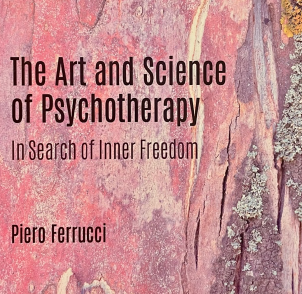
Piero Ferrucci
The Art and Science of Psychotherapy: In Search of Inner Freedom
2025 Cambridge Scholars Publishing 1
Review by Jan Taal
Based on 56 years of experience, psychotherapist and philosopher Piero Ferrucci wrote this monumental book on therapeutic psychosynthesis. He put all his experience and knowledge – and I know from personal experience that this is a great deal – into this life’s work. He spent ten years working on it. In 559 pages, Ferrucci shares his vision of psychotherapy and substantiates it with scientific knowledge and many practical examples. He presents 50 themes plus one extraordinary one. Almost all aspects of therapy are discussed, from exploration to transformation, the transpersonal realm and integration into the reality of life.
The back cover of the book states: all living is relationship and the rapport between therapist end client is central. Body states, breathing, posture and the voice reveal the client’s emotional state. Metaphors and imagery are the language of the unconscious. Traumas are tackled with a view to recovery and renewal. Meditation, writing, and visualization help clients explore the inner world and give shape to their existence. Will and the sense of agency are essential to wellbeing. Expansion of consciousness and peak experiences are pointers to healing and freedom. Even in the roughest times, it is possible to find one’s own center.
Ferrucci refers to caring for others as perhaps the highest and noblest thing a person can do. The warmth of genuine care is essential in the therapeutic relationship. But he also describes in detail how this can be overshadowed and undermined in a therapeutic relationship by processes within the therapist himself. In particular, the therapist’s need to help, which is often driven by a need to be liked and appreciated, can seriously hinder the client’s autonomy and their ability to find their own solutions.
The need to help is something I recognize very well myself. I sometimes wonder what my life would be like without being able to help. Perhaps ‘being able to help others’ acts as a kind of antidepressant for me, so to speak. In any case, Ferrucci advises care providers to regularly reflect on these kinds of processes.
Ferrucci argues that therapists should take good care of themselves so that they do not let clients suffer from their own unresolved issues. Ultimately, clients will also benefit from this. The book contains many exercises, including those for self-care by the therapist.
The author has a great talent for weaving his vision into stories, stories from around the world, each with psychological and spiritual truths. Very funny I found the story of a well-meaning, caring monkey who helps fish darting about in the water to calm down by placing them on a rock.
In another astonishing story shepherd Manish asks God Krishna to explain him the secrets of life’s illusions . . . It is best that you read Krishna’s surprising answer yourself in the book.
Regarding excessive diagnosis in psychotherapy, Ferrucci says that diagnoses mainly reassure therapists, but that they usually get in the way of truly meeting the person. He even calls it a collective delirium. No one, he writes, wants to be placed in a category. Clients want to be met as unique individuals, as people with many layers and processes, unique in a way that no one else is. ‘Each person has within herself a seed that’s different from everyone else’s. Each person’s mission on this earth is to cultivate this seed, protect it, help it to germinate’. A recent overview of the consequences of psychiatric classifications confirms his view (Veldmeier et al, 2025).2
Ferrucci’s discussion of the themes of shadow, shame, despair and death is particularly interesting. ‘Facing the abysses of the soul strengthens us and elicits an influx of fresh energy, ideas and desire to live . . . Trust in the therapist is a precondition for meeting face to face with the shadow . . . The therapist too shares this process. Each time he goes down the path of no return, and shares an adventure that can have exceedingly arduous moments.’
I found Ferrucci’s anecdote about the workshop entitled ‘Humour is a serious matter’ that he gave with his colleague Diana Whitmore hilarious. It was a subject of great value to them, as their teacher Roberto Assagioli saw humour as a quality that uplifts people, a healing balm. However, it turned out to be a dreadful workshop, in which humour was examined very seriously, came to a slow end and there was not a single laugh or any lightness to be
found. A few years later, Ferrucci writes, I saw a short note from Assagioli: ‘Don’t talk about it much.’ 3
The ‘extraordinary’ part of the book is the section that falls outside the 50 chapters, or rather transcends them. It is marked with the symbol Aleph, symbolizing unity, origin, and the transpersonal, the infinity of the soul.
In the multitude of experiences, good and bad, emotions and events that life offers, for the author, the lack of a pure point of reference is the source of all psychopathology. He writes that we must realize that the ‘I’ (or Self) is originally unchanging and pure. Realizing this sets us free and gives us strength, because then we are no longer constantly swept away by the continuous, unforeseen flow of events and emotions. On the contrary, ‘being pure’ is like a beacon that remains stable in the storm. Hence the subtitle of the book: In Search of Inner Freedom.
According to Ferrucci, with the realization of this pure point of reference within ourselves, we have an instrument with enormous scope, and psychotherapy enters a new dimension. He quotes from Eastern and Western philosophy and traditions, including Plato, Meister Eckhart, the Grail legend, the Tibetan Book of the Dead, the poets Dante and Abar, and, of course, frequently from the work of Assagioli. When we can reconnect with our pure center—the Self is our face before we were born (Zen saying)—we can be free and learn from the challenges and hardships in life. The author considers the Self to be a kind of sanctuary to which we can return to find safety and inner stability. He sees Assagioli’s disidentification exercise as an important tool in this process.4
Ferrucci believes it is important in therapy to see the person in front of us as a Self. Then we see his true being, potentials and qualities. And the client will sense this, which can influence the course of therapy in a powerful, positive way.
In the last part of the book, the author describes 32 examples from practice, not complete case descriptions, but each chosen for specific aspects of psychotherapy. They are instructive and emotional testimonies of how therapeutic processes develop and also highlight the function of specific techniques, including subpersonalities, dreams, imageries, metaphors, the body as a timeless generator of metaphors, disidentification, writing, coincidences, synchronicity, and the use of one’s own wisdom.
For Ferrucci, it is not the therapist who ‘heals’ the person. Every healing is a self-healing. Every process towards health and wholeness is self-generated. It is fitting for the therapist to be humble. Therapists merely have the privilege of being present, he writes, and perhaps the wisdom of moving out of the way, because they are not the protagonists. Not that Ferrucci’s approach to therapy is only gentle. No, he believes that for psychological recovery it is important to go directly to the source of the affliction. He quotes Rumi, do not turn away: keep looking at your wound, because that is where the light will enter you.
Ferrucci believes the work of a therapist should be reduced to its essence. No tests, no diagnoses or waiting rooms, no white coats, no pompous language. ‘The client knows how to find her way. I guide her in that process; the less I do, the better’, the author writes.
It’s true, during my studies in psychosynthesis, I was often a client and supervisee in his therapy studio and indeed experienced the simplicity of Ferrucci’s listening and moving with my process. He wants to remove the fuss from therapy; he wants to be like trumpeter Miles Davis, whom he quotes: ‘I always look for what I can leave out.’
Yet in the descriptions of practical examples, I also experience Ferrucci’s input, his wisdom, and I read suggestions and invitations to delve deeper with different techniques. Perhaps he doesn’t seem to be doing much, but his presence is palpable and it is not merely neutral. Just as Miles Davis’ music is not neutral, Ferrucci’s book exudes authority and lived wisdom, colored by the author’s life experiences, craftsmanship, and culture. In the book, he also shares his thoughts, concerns, doubts, and mistakes with us, allowing us to get to know Piero Ferrucci as a person.
In his examples, Ferrucci often writes about his clients’ imagery, dreams, visions, and symbols, and he is an expert in using these. Texts written by clients are included in the book, but unfortunately, the book does not contain any graphic illustrations or photos. Take Paula, for example, who has a premonition the night before a mild heart attack, an important dream: an old heart is torn and through the tear emerges a new, young heart. Later, Paula sculpts the two hearts in terracotta, with the edges of the tear colored gold. On the edge sits a blue bird, peering curiously into the tear. The new heart emerging from the old one heralds a new phase in her life, free from the past, free from daily interferences and everyone’s else’s worries. I would have liked to see photos of this sculpture, as well as other illustrations of clients’ imageries and artwork. That would have made this book even richer and more accessible.
It is interesting how Ferrucci explains how he himself has benefited from Paula’s artwork. As therapists, we are not just a mirror; the client’s process obviously also has a major impact on us therapists, he writes. After all, in our therapeutic practice, we naturally participate in people’s inner experiences, although it is always essential to remain centered and to respect the client’s personal space. What is moved in a client tends to move some elements in the therapist as well, and he can also benefit from this. For Ferrucci, it is crucial to be aware of such possibilities, because they can be a sign that the therapeutic work is progressing. The therapist’s growth is, of course, a side effect: the client’s growth is central. But if the therapist deems it appropriate, he can also share his benefit with the client. In our kind of work, the journey is always made by two, he writes.
Ferrucci writes some essential truths about grief that, in my opinion, are of the utmost importance in the grieving process: the deceased person remains in our lives and continues to participate in our lives. Our relationship with that person changes over time into something essential. The details of everyday life disappear, it becomes the relationship itself, simple and pure.
In his summary of working with trauma, Ferrucci writes that reliving a trauma is effective. Although he mentions it to be a technique to be used with great caution and no insistence, in my opinion he does not sufficiently address the disadvantages and pitfalls of reliving (exposure). Admittedly, reliving can be useful as an intermediate step, as it allows trapped emotions to be released. This can help to cleanse the psychological trauma wound. If the person can handle it (sufficient I-strength), reliving can also provide more insight into what has been damaged and what is needed for recovery. However, in cases of severe trauma, reliving can be counterproductive, as it can be perceived as unnecessarily cruel and increase and exacerbate suffering. Disruptive re-traumatization and an intense increase in fears and other destabilizing emotions can result, possibly even leading to an increase in depressive symptoms or self-harming behavior. In cases of prolonged exposure, dropout rates of more than 50% have sometimes been reported. In recent years, there has been increasing evidence of the effectiveness of trauma treatments that do not involve reliving the trauma. In healing a trauma, I believe that the focus should be entirely on what has been wounded in the person and what they carry with them in the present as an open, unhealed wound. The focus should be on healing that psychological wound. It is the transpersonal resources, about which the author writes extensively in ‘the extraordinary chapter (Aleph) that is not a chapter’, that offer important entry points to healing factors and energies in cases of severe trauma, without reliving the experience. Reliving can only be useful if there is sufficient I-strength.5 6
Conclusion
With this monumental work, Piero Ferrucci has created a standard work in the field of psychotherapy. It is a formidable work, with a profound reflection on the profession of psychotherapy. It is valuable for practitioners of all types of psychotherapy and for anyone involved in the mental health care of people.
How to read this comprehensive book? It is such a thoughtful, in-depth work that, in my opinion, it is impossible to read it in a short period of time. It took me more than six months to read it, but admittedly, I am not a fast reader. The reader will have to make choices and select the topics that are important to her.
The book is rich with wise lessons and reflections from a seasoned colleague. A colleague who does not shy away from introspection, because, as he himself writes: ‘All psychotherapists have flaws, starting with myself.’ His own experiences with transference are therefore also discussed in the book.
It is also a philosophical book, in the rich tradition of modern transpersonal psychology, the most important development in human studies in the 20th century and up to the present day. While reading, you also get to know Piero Ferrucci as a person, his approach to his profession, in simplicity and depth, his broad cultural background, his way of thinking about human dignity and origins, and also his doubts.
As mentioned, this is not a book that can be read in one sitting. It covers too many topics and goes into too much depth for that. I therefore find it unfortunate that there is no index of themes and concepts. Ferrucci’s book can also serve as a reference work, and it would be wonderful to be able to use an index to find what the author has to say about specific themes. For a future edition, I would suggest adding an index, or a digital version thereof. It will make this rich standard work on psychosynthesis psychotherapy even more accessible.
Jan Taal, Amsterdam, 2026
About Jan Taal
1 Available from https://www.cambridgescholars.com/product/978-1-0364-6910-8
2 Veldmeier, L., Terlouw, S, Boonstra, N & Van Os, J. (2025). Opening doors or building cages? The adverse consequences of psychiatric diagnostic labels. Current Opinion in Psychology. 65:102076.
3 In 1969, psychotherapist and philosopher Piero Ferrucci met psychiatrist Roberto Assagioli, the founder of Psychosynthesis. It turned out to be a crucial encounter. Ferrucci was taken on a journey, he writes on his website. A journey that brought about a profound inner transformation and an extraordinary broadening of my perspectives, both personal and professional.*
After Assagioli’s death in 1974, Ferrucci became an important writer and international trainer in the field of Psychosynthesis. He is president of the Italian Society of Therapeutic Psychosynthesis. Piero Ferrucci has written a series of books: What We May Be; Inevitable Grace; Introduction to Psychosynthesis; What Children Teach Us; The Power of Kindness; Seven Paths to the Self. Beauty and the Soul; Your Inner Will.
*www.pieroferrucci.it/psychosynthesis.html
4 The disidentification exercise is an important meditative psychosynthesis exercise. In short: ‘I am more than my body, feelings, and thoughts; I am the center of pure self-awareness.’
5 Rubenstein A, Duek O, Doran J, Harpaz-Rotem I. (2024). To expose or not to expose: A comprehensive perspective on treatment for posttraumatic stress disorder. Am Psychol. 2024 Apr;79(3):331-343. doi: 10.1037/amp0001121. PMID: 38635195; PMCID: PMC11034887.
6 Taal, J. & Krop, J. (2003). Imagery in the treatment of trauma. In: Sheikh, A. A. (ed.) Healing Images. The Role of Imagination in Health. With a foreword by the Dalai Lama. Imagery and Human Development Series. p. 396-407.
Available at www.imaginatie.nl/achtergrondartikelen/en