
By Mark Skelding
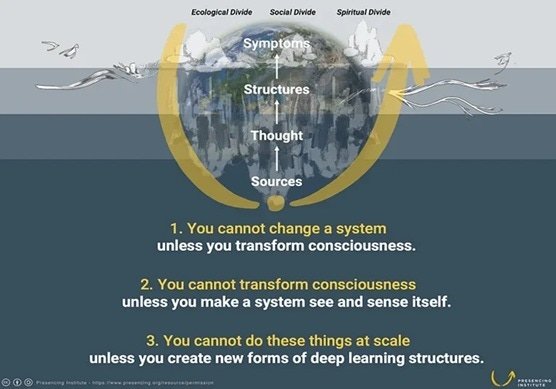
Presencing Institute: Theory U – As we move down the left side of the U, we allow ourselves to connect with the world outside our organizational bubble. Reaching the bottom of the U, we suspend our common assumptions and thinking, letting come our highest future possibility. Finally, as we ascend the right side of the U, we bring forth the new into the world.
Choosing a theme of “Peace” for the AAP Quarterly seemed a great idea. After all, Assagioli had written “cultivating peace is not a spiritual luxury, but a daily necessity for all those who want to maintain their inner integrity and not be swept away by the collective currents of agitation and frenzy. And cultivating peace is also, and no less, a duty towards others.”
There is no shortage of “collective currents of agitation and frenzy” in today’s world. In fact, it often seems to be driven by them. And yet, the theme has not generated a flood of creativity and collective sharing of techniques and insights into our various practices of peace and centre. This prompts some reflection.
Perhaps the complexity of the conflicts dominating our attention evokes head-shaking stasis and silence? After all, what is there to add given the preponderance of talking heads on a myriad of screens, the content carefully chosen by algorithms to reflect viewers’ assumed worldview? Maybe we are simply shocked to our souls by the flagrant manipulation, distortion, cynicism and deceit we have to wade through on a daily basis. Or is it that we are able to park these events, to consider them as a slightly unexpected and definitely inconvenient twist soon to return to business-as-usual? All of the above…?
And maybe there is something else at play – perhaps more shocking still? What if some part of us has always been profoundly connected and open to fluctuations of the life-force, just as our 6th sense can often pick up a change in the mood of a room or place? And what if, at that most visceral, embodied level, it is no longer possible to ignore the information that the structures upon which our world, and our identity within it, has come to depend, are at odds with all that is generative and whole?
_______________________
One of the great achievements of Modernity has been to see things in terms of binaries. This and that. Mine and yours. Ours and theirs. Them and us. Mind and body. It makes it easy to isolate and recognise identified, set pieces within the composite jigsaw of daily life. It makes identifying a problem easier: the damaged knee, the worn out brake pads, the addiction. Given the technology, these can be fixed and you’re on your way. But if the problem is caused by something more systemic—a weight issue, your driving style, or a dysfunctional relationship—you’re likely on your way to repeating the problem. The “problem” is information, feedback from the system, and it will increase in intensity or duration, or both, if it isn’t addressed systemically.
Of course, stuff happens and things wear out as part of their cycle. But, when multiple elements of a system are stressed or dysfunctional at the same time, it suggests that the process in which the elements are involved—the system itself—is failing, or reaching the end of its own cycle, and has been for some time. This is challenging where one is identified with the process, whether in part or whole. Assagioli puts it thus: The normal mistake we all make is to identify ourselves with some content of consciousness rather than with consciousness itself.
Assagioli’s understanding recognises both consciousness and will as phenomena which precede our knowledge of them: we first encounter and engage both consciousness and will as embodied phenomenon. The knowledge—and meaning-making—occurs when the visceral information catches our attention and we organise it in accordance with context derived, in part, from our world-view. As perceived phenomenon they become inclusive of, yet more than, any personal meaning or individual context we apply to them. Both body and mind are dimensions of both consciousness and will. And neither consciousness nor will begins or ends with me—or, for that matter, any other expression or meaning given to it. The first words of the Tao te Ching remind us of this—the Tao that can be spoken is not the true Tao— and are relevant to any reflection on consciousness or will, or “peace”.
Peace and the equilibrium of our world systems appear to be deeply challenged by a human-centred, self-serving identification with and understanding of consciousness and will. Disavowed and disembodied, yet embedded and enshrined within our foundational institutions, such identification is at odds with inter-systemic world processes upon which we depend. And of which we are part. Thus, we would expect that more and more of these systems would show signs of imbalance—including our individual and collective human systems.
This has been the case. The DSM has grown from a spiral-bound 130 pages describing 106 conditions to a hefty 1000+ pages describing over 300 conditions. Distressingly, whereas it was previously seen that older demographics carried the burden of mental health issues, there has been a marked, decades-long shift. Depression, anxiety, and self-harm disproportionately affect younger generations globally.
Depression is often described as anger turned inwards; anxiety is a product of unresolved disappointment and the mismatch between expectations and anticipation; and those inflicting self-harm often describe it as a response to feeling unreal. These states are evidence of how systemic disequilibrium shows up in our lived experience. Biologist Andreas Weber notes that such “all-encompassing and inescapable relatedness makes the world capable of perception, capable of learning, imaginative, and sensory”.
Our sense of being is a sentient experience of consciousness; our way of being is an embodied expression, and therefore will in action. Where we can move our attention between these states, we can usefully reflect on each, consciously directing attention within a sense of wholeness that includes body, feeling and mind, as well as a greater sense of Self, to make meaning and respond to the world.
However, the fusion or conflation of experience with expression diminishes or limits our capacity for reflection on either state, limiting our availability to creativity and choice. Both ex-perience and ex-pression are aspects of ex-istence. The “ex” implies some sort of emergence, a coming out from a deeper, richer and largely unseen level of possibility. In making ourselves available to this possibility, we make ourselves available to being called forth into relationship with this deeper level.
For Weber, this is “the feeling of love [in which] we inwardly comprehend the practice of being alive, which is manifest through the body… the strongest connecting link between the emotional interior and the bodily exterior, solid proof that both are aspects of the embodied existence”.
Systems thinker and curator of the Bateson tradition, Nora Bateson has coined the term “aphanipoesis” from the Greek words, aphanis/afanis – obscured, unseen, unnoticed, and poesis – to bring forth. Afanis, she writes, “has the implied meaning of ‘something standing back in the shadows, in humble quietude’.” It speaks to a symphony of life, a coalescing of unseen factors toward vitality in living systems in which bio-psycho-synthesis is a movement, bringing forth. Psychosynthesis therapist, Susan Holliday, writes of “a submerged wellspring which conceives life in all its particularity of meaning and sometimes difficult beauty”.
We can conceive of “peace” as being a capacity to trust that there is always “something standing… in humble quietude”, a possibility that can rarely, perhaps never, be held and realised by a single being, no matter who leads us to the doorway—including ourselves. As the Zen koan advises “if you meet Buddha on the road, kill him”. The koan reminds us to forgo preconceived notions, attachments, and external dependencies in favour of the direct, unmediated connection.
While Assagioli side-stepped answering Sam Keen as to wholly nail down and define transpersonal experience, his acknowledgement of the symbolism of language used to describe it is interesting: “enlightenment, descent into the underworld of the psyche, awakening, purification, transmutation, psychospiritual alchemy, rebirth, and liberation.”
We might ask “is this order entirely random?” Although there is surely no set process, these words could be read as pointing to enlightenment as a first step. By lightening the load – killing the Buddha – we can descend into the underworld of the psyche. Like any basement, we may find it cluttered by a whole lot of outdated, avoided or forgotten content. However, like any basement, it is also the space created by the foundations upon which the house – ourself – is standing, solidly connected to the Earth. Such a moment invites an awakening to our unbreakable connection in the interiority of the living world itself, our visceral engagement with possibility, and to recognise our capacity to align in its realisation in context.
This is a challenging invitation: it offers no hope, beyond that which arises from the trust we may build in the process itself. As David Whyte writes (Revelation Must Be Terrible):
When you open your eyes to the world
you are on your own for
the first time. No one is
even interested in saving you now
All that stored baggage and “forgotten content” is suddenly immaterial—you are on your own: there is nothing to be saved from anymore. Trauma – described by Levine as “an interrupted gesture” that has become trapped in one’s body instead of processing through and integrating transformative experience – can be released: one’s identity no longer secretly depends upon it. And, sure enough, the world and your body connect:
… the world steps in
to test the calm fluidity of your body
from moment to moment
as if it believed you could join
its vibrant dance
of fire and calmness and final stillness.
Assagioli: In Chinese the ideograph for wisdom is a combination of wind and lightning. So the wise man is not the one who is serene and tired but one who can no more be captured than the wind and who strikes like lightning when necessary.
Wisdom is connected with intuition, (that is why she has been seen as a woman – Sophia) and with seeing things whole, and so it links up with the transpersonal perspective. It is the power to play with opposites and to establish a synthesis. I suppose that age helps one to acquire some of the perspective necessary to create harmony among the apparent contradictions.
A worldview of binaries offers exactly the conditions to practice such perspective. Assagioli may have been speaking to the perspective of age in the context of human developmental process, but today it seems that the culture itself is maturing rapidly. Something is stirring across a remarkable range of disciplines — neuroscience and ecology, depth psychology and plant biology, Indigenous cosmology and quantum physics. From such diverse starting points, and more, researchers and practitioners are reaching the same recognition: that the living world has an interior dimension, that feeling and meaning-making are not accidental features of complex nervous systems but intrinsic to life itself, and that the deepest crisis of our time is not primarily ecological, environmental, social or political but perceptual — a severance of the felt connection between human beings and the living whole of which they are part.
Despite a basement filled with Modernity’s cultural baggage, the foundations of our house are again becoming clear again. We do not have an interior dimension of our own. Rather, we are a unique flowering of “life in all its particularity of meaning and sometimes difficult beauty.”
To embrace this requires trusting in the processes of Life. The research from varied perspectives suggests that evolution, individual and collective, is fractal, following certain guiding patterns. David Whyte refers to “a ground of truth onto which we have yet to alight and that we do not as yet know how to alight upon it”.
However, our bodies may know already, having already withdrawn our energy to some degree, waiting for the appropriate moment to arrive when response is possible—as researchers Martin Seligman and Simon Meier found when they reviewed their original research and published “Learned Helplessness at 50” complete with an apology for misrepresenting the intelligence that bodies themselves exhibit in withdrawing energy from an unsustainable situation. What might such a perspective tell us about depression, anxiety and self-harming? The suggestion that the broad public is disinterested or caught up in denial and disavowal in regard our predicament may be a misreading – the silence isn’t apathy as much as bodily resistance to perform itself in service to an illusion of optimism.
Assagioli is credited with saying that “the only way through is up”. This can seem to imply that some sort of “higher state” offers solidity or certainty. Jonathan Lear’s reflection on the culturecide of the Crow Nation – including what might be called “purification, psychospiritual alchemy, and rebirth” – suggests that sometimes, like the caterpillar and the butterfly, the only way through is through.
This implies holding true to the values/qualities that underpin and find their expression when both individual and collective needs are met – even when the world-view and attendant behaviour previously seen to meet these needs is no longer possible. To sustain and deepen such insight is more than a solitary crusade, even when some—Greta Thunberg springs to mind—may begin the process. But even her personal demonstration quickly gathered support. Left unsupported, it would have looked like a naive, childish rebellion; given exposure, it stirred up recognition of something alive and unexpressed in many people; in connection, it furthered a social transmutation.
Some of us within and beyond the Psychosynthesis community have envisioned a means whereby we can witness one another, friends and strangers alike, as glowing lights of change around the world. The PeaceWave Collective draws together these lights, locates them on the globe and reflects them back. And does so, anonymously, because these diverse centres demonstrate often very different expressions of an evolution-old consciousness and will that we can feel, engage and express directly within ourselves.
To engage, we must examine the pattern and impulse of Life evolving as we know it in our being, recognising these in the very real needs that must be met if the pattern is to continue. It is then that we can begin to surrender attachment or identification with any particular form, even a millennia old tradition such as was required of the Crow nation. We not only need each other for support as we do this, but also we need each other so that we can be curious about both the needs and the qualities associated with them. My values around freedom, respect and integrity may be different to yours, but both of us have only a partial understanding.
The PeaceWave project encourages sharing a plethora of very different activities that can demonstrate and celebrate such diversity. Its name derives from the wave of birdsong that is constantly circling the turning globe as night becomes day. Each bird has a different song, and they no doubt inspire each other to volume and complexity. And yet—as far as we know—they can never know the fullness of the process in which they are involved.
Our local or individual acts of creativity in response to our apparent predicament are not really solutions to a problem. That would be a predictable, binary appreciation informed by an idea of peace or equilibrium as being some sort of end-point, rather than a dynamic state marked by multiplicity, difference and uncertainty.
Exploring these differences together may bring us toward Holliday’s “sometimes difficult beauty” but Peace is not the absence of conflict. It is the state of recognising that no matter how the world is changed or context shifts, Life’s needs remain unchanged. Weber again: “The reality, for which we have so little respect currently, is not reducible: it is unpredictably creative. But even so, it follows certain rules, just as the butterfly’s flight through the air is unpredictable and also follows physical laws.”
This is why the often overlooked second tree in the Genesis story is so important—before eating the fruit of the Tree of Knowledge, we should digest that of the Tree of Life. It is there that we engage and embody the rhythms and cycles of the fractal processes of living, experience them as transpersonal qualities of being, and can step them down into the common sensing of the living world.
We began with the graphic of Theory U that invites us to recognise the system of which we are part, and, in the seeing, begin to transform the consciousness that the system reflects. But to do so requires structures of deep learning. It is here that the synthesis of visions informed by a deep reading of the world is so urgently required, a next step in an evolutionary journey that is as individual as it is universal, and always points us homeward.
And the end of all our exploring
Will be to arrive where we started
And know the place for the first time.
Through the unknown, unremembered gate
When the last of earth left to discover
Is that which was the beginning…
T S Eliot
The Solstice Peacewave was held June 20-22. To see details of what was involved, and to find your place in this personal project, please click on: https://www.peacewave.world