
By Molly Brown
(The following article by AAP Steering Committee member Molly Brown has just been published in the October 2025 edition of Psychosynthesis Quarterly. The article was adapted from a new Foreword to Unfolding Self, in Swedish translation, 2025).
Our world is changing around us in ways that are both frightening and promising. On the one hand, we see fragmentation, conflict, and threats to our very survival through environmental and climate degradation, rising fascism, and global warfare. On the other, we see movements toward a more sustainable, harmonious way of life and a collective liberation from human oppression in all its forms—a development that Joanna Macy and others have called “The Great Turning” (Macy & Brown, 2014).
These phenomena represent two sides of the same coin. Both are expressions of an evolutionary paradigm shift toward a recognition of our interdependence with all people and all living beings of Earth. That paradigm shift challenges most modern institutions (mainstream psychology among them), which have been built around a view of people as separate competing individuals and groups. Institutions that no longer serve the best interests of all of humanity must transform—or they will collapse. Tragically, this collapse is harming innocent people as well as whole ecosystems, causing enormous suffering and death.
On the other hand, conflict and collapse reveal the faultlines of existing paradigms and structures, showing people where and how change is most needed. The breakdown of old forms can open up new vistas of possibility, evoking creativity and hope.
This evolutionary paradigm shift challenges us to develop and reclaim a spiritual psychology that meets the demands of the times. We need to reach back to our indigenous roots to rediscover a way of living in harmony with the living web of life. We need a psychology that honors and balances all the dimensions of the personality: intellect, emotion, body, intuition, and imagination. We need a psychology that helps us find courage, wisdom, patience and compassion – qualities that are deeply needed in this time of paradigm shift and planetary crisis. We need a psychology that helps each of us to connect with our inner spiritual Source and tune in to the guidance arising from that Source.
I understand the term “psychosynthesis” to be synonymous with healthy human development, the ongoing process of integration and synthesis that every human can experience if given nurturing, supportive life circumstances. Facilitating that process is what really matters, and what formal Psychosynthesis aims to do. The theory and methods of psychosynthesis can be applied in most areas – education, personal development, health, business, social activities, even politics.
The founder of psychosynthesis, Roberto Assagioli, formulated his initial insights about the personal self, the Higher Self, the will, etc., believing that his followers would continue to evolve and expand them. We need to keep learning from each other—and from Life.
My own understanding of the theory and workings of psychosynthesis has been broadened and clarified through my work with clients and my own development, through exchanges with colleagues, and through reading and study. Since 1990, I have also worked extensively with Joanna Macy and “the Work That Reconnects,” attempting to bring the insights of psychosynthesis into the field of social action, and the perspectives and passion of social change movements into the field of psychosynthesis.
How can we bring the powerful healing and transformative principles and practices of psychosynthesis into activist movements? How can psychosynthesis support and even shape the desperately needed radical changes to our societies, economies, and political structures? This will be challenging, because many people dedicated to social change have limited funds to pay for workshops and/or therapy/counseling/coaching. And in the current political horror-show of today’s United States, funding from grants may be harder to come by. The psychosynthesis community will have to find creative ways of bringing psychosynthesis to people in social change movements, on behalf of all life and for the well-being of future generations.
Could psychosynthesis be offered to social change organizations in our local communities for free, or at low cost? Some organizations might be able to find their own funding for this purpose. I can also imagine psychosynthesis programs offered publicly on a donation basis, or with scholarships for activists and others with limited financial resources. Perhaps the AAP could seek grants from foundations for a general scholarship fund for this purpose.
Another challenge: psychosynthesis practitioners are mostly of white European ancestry. To avoid the Great White Savior syndrome, we need practitioners from the Global Majority to offer programs to their communities and cultures,. That means making a concerted effort to center the few BIPOC practitioners we have, and to support their efforts to offer training to their communities. In addition, white facilitators can partner with BIPOC facilitators whenever possible. At the very least—and alongside those partnerships—those of us of white European ancestry can work to unlearn our unconscious racism, sexism, ableism, and other biases so that we minimize bringing those social-ingrained attitudes, assumptions, and habits into our teaching and facilitating.
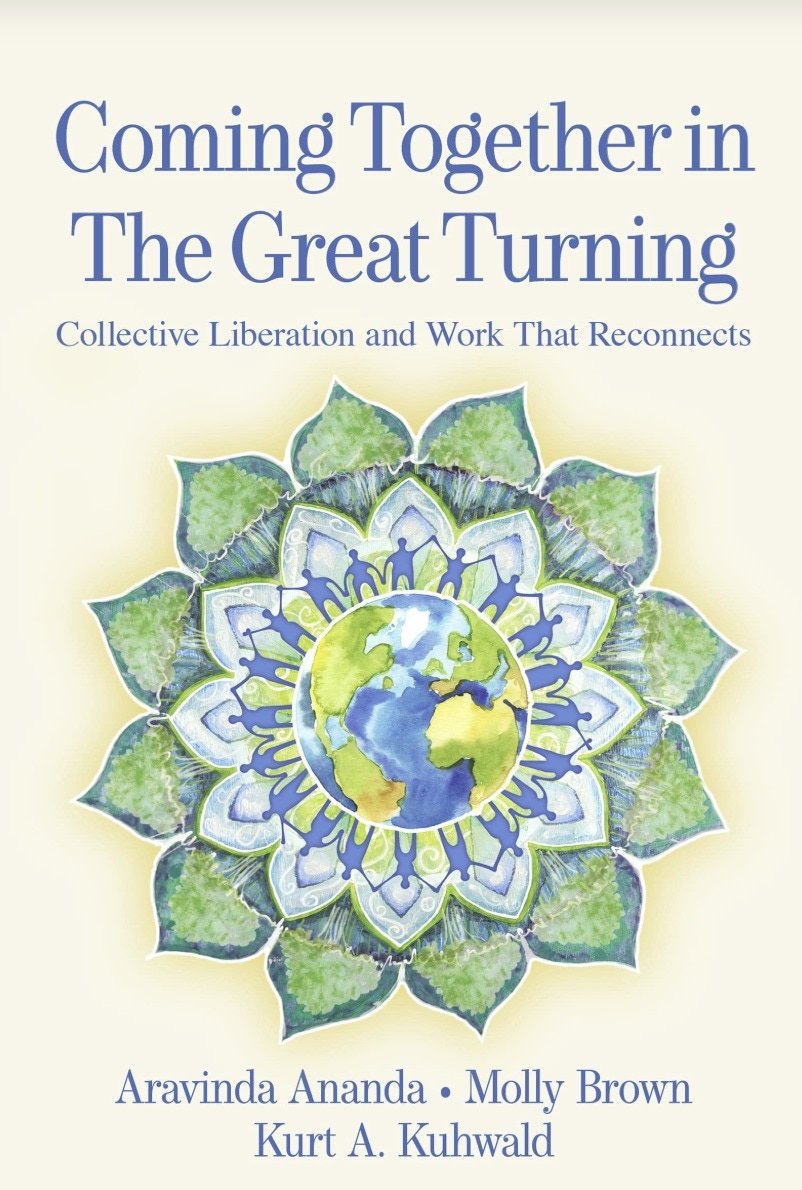
For this purpose, let me shamelessly recommend a book I recently co-authored/edited, to be published this November through New Society Publishers: Coming Together in the Great Turning: Collective Liberation and Work That Reconnects. We author/editors deliberately left “the” off of “Work That Reconnects” in the subtitle because we know there are many forms of “work that reconnects” beyond the modality that carries that name. I propose that psychosynthesis is indeed one of them.
I look forward to continuing the dialogue because it is when we work together that we best utilize our resources for the common good. As Dr. Assagioli envisioned: “Let us realize that we can make a contribution to creating a new civilization, characterized by a harmonious integration and collaboration imbued with the spirit of synthesis” (Assagioli, 2000).
REFERENCES
Coming Back to Life: The Updated Guide to the Work That Reconnects Paperback by Joanna Macy and Molly Brown (New Society Publishers, 2014)
Psychosynthesis: A Collection of Basic Writings by Roberto Assagioli (Synthesis Center Inc, 2000)