Greed, Fear, and Love
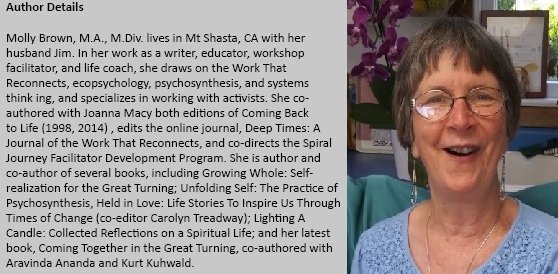
By Molly Young Brown
For some time now, I have been distressed about the level of greed in the corporate world today, and its destructive effects on our social and economic institutions, especially—but not exclusively—in the United States. The scale of this greed became glaringly apparent in the multi-billion (or is it now trillion?) dollar bail-outs of failing financial institutions in the US in 2008 and since, with most of the funds lining the pockets of the very executives who drove their companies into ruin. We’ve also seen colossal greed in the Republican Big Beautiful Bill of 2025, which robbed the poor to feed the wealthy. Greed seems the primary driver of the health insurance industry’s lobbying against any kind of public health insurance or any meaningful reform of the current profit-driven system. Greed drives the oil and coal companies to mislead the public about global climate change and the need to immediately reduce our use of fossil fuels. And far too often, greed for campaign contributions and other favors moves too many of our senators and representatives to favor corporate interests over the health and well being of the citizenry and the environment.
Lest someone worry that I am “giving energy to the negative,” let me say that my attitude is one of curiosity and empathy more than anger—although of course I feel angry, too. I really want to understand the underlying dynamics of greed, in order to discern how this destructive force can be at least mitigated, if not healed—for the benefit of all concerned.
The Buddha named three primary causes of suffering in his Second Noble Truth: attachment (desire, greed), aversion (hatred, fear), and delusion (confusion, ignorance). Buddha’s teaching seems to have withstood the test of time, so we can assume that when people are driven by greed (and/or fear and ignorance), they suffer—along with the victims of their greed. It’s important to remember this, because it is all too easy to feel outrage at their behavior and believe that they are happily enjoying the fruits of their greed. In fact, they are far more likely to be frantically planning their next acquisition, because there’s never enough.
Fear and Deprivation
Many who have thought about this issue have concluded that greed arises out of fear—and that’s probably often true. Many people have suffered from some lack in their childhood, at the lower levels on Maslow’s hierarchy of needs—lack of sufficient food, clothing, shelter, or basic safety and security. Fear of falling back into such deprivation can drive such folks to acquire more and more money and stuff, in order to stay safe from “the wolves at the door” (a term that gives actual wolves an unjustified bad rap).
In other cases, however, the motivation behind greed may reflect deprivation at a higher level of Maslow’s hierarchy: what Maslow calls our belonging needs, and I would call our need for unconditional love. Love and greed do seem to have a common root: attraction. Unfortunately, when children’s natural attraction to their parents is not met with a loving, connecting response, this unmet need can grow into grasping and greed.
Moreover, mainstream society teaches us through the media that money and material goods will make us happy, so many people pursue them in hopes of fulfilling their need for love. Wealth also bestows a sense of being special, even superior to those of lesser means—and this may give the wealthy the sense of belonging they so desperately need. All the astonishingly greedy people in today’s world, many in positions of considerable power and wealth, may be suffering from lack of love and belonging during and since their childhoods. And knowing this can evoke our compassion instead of contempt.
Feeding Frenzy
There seems to be a feeding frenzy going on right now, on a scale perhaps never before seen so clearly by the public. Major stockholders and executives—in the financial, health insurance, pharmaceutical, oil and coal, chemical, and weapons industries—all seem to be snatching up as much as they can as fast as they can, perhaps because they know the end is in sight. Indeed, they have seen many of their fellows disgraced and even jailed in recent years—until President Trump pardoned them (for a fee). They must feel profoundly insecure! As I thought about this epidemic of greed, it occurred to me to consider this group of people as a subpersonality of humanity, or at least of Western industrial society.
In psychosynthesis, “subpersonality” refers to a constellation of emotions, beliefs, and behaviors that operates largely unconsciously in our lives, even when we think we know what we are doing. Subpersonalities arise from our need to adapt to the challenges, traumas, and circumstances of our lives, especially in childhood. Psychosynthesis offers some effective ways of working with subpersonalities, to discover their underlying dynamics, meet their needs from a centered place, and reintegrate them into the personality as a whole.
This could be a useful concept and technique to apply to communities, nations, and even to humanity as a whole. Because the same patterns tend to operate at different systemic levels, we as individuals may well have similar subpersonalities riding around inside us. This factor may enable us to discover how to heal and reintegrate our greed-driven collective subpersonality into the whole society in a way that serves the common good. I propose that greed of this magnitude arises out of a love deprivation in childhood—that this subpersonality (a stereotyped oligarch or corporate CEO) came into being to try to compensate for a childhood of minimal meaningful relationship with parents, no matter how much material wealth was present. (I could go into a lot of detail here, but I will leave it to your imagination.)
I think this subpersonality wants to feel important and powerful, wants to feel secure that they can have whatever they want, whenever they want it. But what does this subpersonality really, really need? They probably doesn’t know what they need, only what they want. So we have to step back, into center, into a compassionate Observer, to perceive or intuit what they really need. What comes to me is this: they need to know they exist, that they are significant, that they matter, as themselves. They have found a way to feel self-important, but that is a poor substitute for what they really need. This subpersonality needs the loving mirroring, the unconditional love of a father or mother—or both. Then they would know they exist. Now their significance is tied to their wealth, so they must cling to it and enhance it however they can. Losing their wealth is untenable, because they would then cease to exist in the eyes of those around them. So when their wealth is threatened in any way, they will fight for it tooth and nail.
How in the world can we meet such a need? We are by and large cut off from any direct contact with these people, and even if we could see them in person, they have huge walls and defense systems built around them. However, we know that prayer, visualization, and directed thought can have an effect. What if we gathered together either in groups, or at specified times wherever we are, and sent unconditional love to this collective subpersonality? We wouldn’t need to direct this at any particular person, but rather at this “complex” among us. And even if we can’t effectively meet this need, at least having a sense of it could change the way we think about such folks when we read about them in the news, or see one of them on television. Instead of arousing our ire, they might instead stimulate our compassion—and who knows what impact that might have on their psyches over time?
A third question we usually ask about a subpersonality is: what does it have to offer? What are its gifts, manifest or potential? What might this greedy oligarch or corporate CEO have to offer the rest of society, especially if their needs were met, even a little? One thing that comes to mind is: skillful will. These folks have a highly developed will to make money; perhaps it could be turned to a more positive, creative end. That strong and skillful will could help us meet the challenges of global climate change, species extinction, and rising fascism and oppression, if it worked for society’s well-being, instead of merely short-term personal material gain. And will is what our society seems to lack in responding to these crises.
Limiting the damage
Meantime, until we can find effective ways of healing and reintegrating this collective subpersonality, we need to take steps to limit the damage it does, just as we would prevent a child from hurting a sibling or a pet. Revising this essay after 17 years, I want to declare unequivocally that enormous harm has been and is being wreaked upon people and planet by this kind of toxic greed, and this harm falls especially heavily on people already oppressed by a racist, classist, patriarchal socio-economic system. Too many people have no alternative but to slave under this system for the few crumbs that the systems bestows upon them to barely keep themselves and their children alive. Much of this slave labor also creates pollution, and destroys the health of soil, water, air, and ecosystems. Yes, we can view the greedy oligarchs with compassion, but we, collectively, must also put a stop to their rapacious behavior however we can.
On a national scale, we can work for campaign finance reform, to remove greed as a motivator behind political decisions. We can bring pressure to bear on our representatives, to work for laws to better regulate corporations and financial institutions. We can boycott the products and services of egregiously greedy corporations. We can avoid investing in corporations that demonstrate this kind of greed, instead seeking out “socially responsible” investments. We can support the victims of greed in our local communities—homeowners facing eviction from their foreclosed homes; employees laid off without adequate compensation; people denied coverage by their health insurance companies. Please see Michael Moore’s film Capitalism: A Love Story, for some examples of this kind of supportive action.
Our collective greedy subpersonality may have other needs and other gifts; I welcome your speculations about this, as well as ideas about how we might meet those needs and make use of the gifts.
Post-script: Meanwhile, some people who have lived in relative simplicity all these years may be able to go on as before, finding their happiness in the creative work they do, in their relationships, and in their communities. Some of them may hardly notice the economic downturn, because their lives are not dependent on the stock market or corporate employment. They are skilled in living on less, forgoing even minor luxuries when need be, sharing what little they have with one another. They can ride through the rough seas ahead with much greater equanimity and ease. I know some of these folks, and honor their resourcefulness and resilience. They have much to teach us all. You, dear reader, may be among them. Bless you!